
A roof leak rarely starts as a waterfall from the ceiling. In most cases the problem creeps in slowly, often months before you really notice it. Recognising the early warning signs prevents high repair costs and structural damage.
Below you will read the 7 signs you should never ignore, with practical examples from our work area in Groningen, Leeuwarden, Assen, Emmen, Drachten, Hoogeveen and the rest of Northern Netherlands.
Why early action is so important
From our daily practice, the same pattern repeats: a small leak repaired in time costs €350 to €600 on average. Anyone who ignores it for two to three years can face damage to roof boarding, insulation and even structural timber. Repair costs then run up to €3,000 to €8,000.
The most common problems we encounter in Northern Netherlands: lead flashing around the chimney that hardens and cracks, ridge tiles blown loose after a NW storm from the Wadden coast, and broken roof tiles on older farmhouses in the Drenthe peat villages. Especially pitched roofs from before 1980 need extra attention because many tiles are not screwed down.
The consequences of an undetected roof leak:
- Wood rot in the roof structure, which begins at moisture levels above 25%
- Mould growth, harmful to both the building and the health of residents
- Damaged insulation that loses its effectiveness (and so higher heating bills)
- Risk of short circuits in electrical installations within the roof
- Stains and cracks on interior walls and ceilings
Damage costs in numbers
Repair immediately: €350 – €600
After 2-3 years of neglect: €3,000 – €8,000 or more
Full reconstruction of roof structure from inside: very high, depending on extent
Sign 1: Water stains on the ceiling or wall
Yellow or brown rings on the ceiling are the most recognisable indicator of a roof leak. They often appear in corners, around skylights, or along the edge of the ceiling. Sometimes you also see discolouration on the upper part of walls.
Important to know: the visible water stain is almost never where the leak actually is. Water follows the path of least resistance and often travels metres horizontally through the roof structure before coming down. The actual cause can be far above or to the side of the stain.
Pay attention to whether the stain grows after a rainstorm. If it gets wetter when it rains, it is almost certainly a leak. If it is only worse in winter, condensation may be the cause (see Sign 7).
Sign 2: A musty or mouldy smell
A musty smell in the attic or in the upper rooms of the house is often the very first sign of a creeping leak, before any water stain becomes visible. Moisture builds up in insulation or wood and dissipates before reaching the inside of the ceiling.
Many homeowners smell something strange but think it is not a big deal. In practice, we see that such a creeping leak can be active for months before becoming visible. Last year in Veendam we had a house where only a musty smell hung in the attic. On inspection it turned out the lead flashing around the chimney had been cracked for years and the entire insulation was full of moisture.
Smell something musty in the attic or an upper room? Take it seriously and have a roofer carry out an inspection before damage gets worse.
Suspect a leak?
Request a quote. We come by, assess the lead flashing, ridge tiles and all vulnerable spots, and give honest advice with no obligation.
Request a quoteSign 3: Loose plaster, bubbling wallpaper or peeling paint
When the ceiling or upper part of a wall starts to bubble, crack or peel, moisture is at work. Moisture is absorbed by the roof structure and walls. Once these become saturated, the result shows as loose plaster, bubbling wallpaper or peeling paint.
This sign indicates that the leak has been present for some time. The moisture load on the structure is already considerable. The faster you act now, the more limited the eventual damage to interior walls and structure will be.
Sign 4: Mould growth in or around the roof
Mould in the home, particularly on the upper floor or attic, is a clear sign of long-standing moisture problems. Mould needs continuous moisture to grow. If you see mould, the leak is no longer a recent problem.
Mould is harmful not only to the structure but also to the health of residents. Respiratory complaints, fatigue and allergic reactions can be the result of prolonged exposure to mould spores.
Visible mould means: act immediately. Not only have the roof repaired, but also have the mould professionally treated.
Sign 5: Problems at the ridge, chimney or broken tiles
From our experience, these are the three most common causes of roof leaks in Northern Netherlands:
- Ridge problems: the ridge is the highest point of a pitched roof and therefore vulnerable to wind. With westerly winds of 100+ km/h, which we regularly see along the Wadden coast, ridge tiles crack or come loose. Water then enters the roof structure directly.
- Chimney and lead flashing: the lead flashing around the chimney provides the watertight connection with the roof. After 30-40 years this lead hardens, cracks appear and it comes loose. In older homes around Appingedam, Delfzijl and the Drenthe villages we see this weekly. A 2 mm crack is enough to let litres of water in with every rainstorm.
- Broken or shifted tiles: a single broken tile may seem harmless, but it creates an opening through which wind drives rain underneath. This kind of damage requires urgent repair, because it can compromise the entire roof structure.
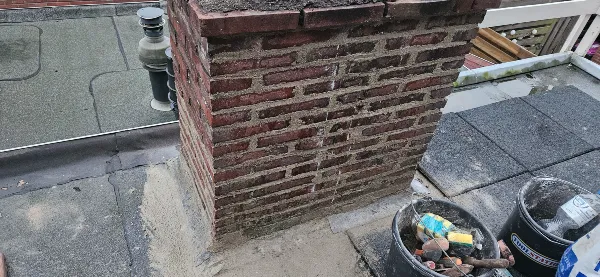
After every storm, take a look at your roof from a skylight or from the garden. Do you see shifted tiles, damaged lead, or loose ridge tiles? Have it checked as soon as possible via our 24/7 emergency service.
Sign 6: Blocked or overflowing gutters
A blocked gutter may not seem like a big problem, but the consequences can be significant. If water cannot drain, it overflows the edge of the gutter. That water can then run behind the fascia boards or under the lowest row of roof tiles.
In winter, accumulated water in the gutter can freeze, causing the gutter to crack or come loose. With the next thaw, melt water then runs directly along the facade or under the roof edge. In the reinforcement area around Appingedam we see extra gutter problems due to subsidence of buildings, where the gradient no longer works correctly.
Clean your gutters at least twice a year, in spring and after leaf fall in autumn. Also check that the gutter brackets are still firmly attached and that the gutter has the correct slope for proper drainage.
Sign 7: Condensation or actual leak? How to tell the difference
Not every moisture problem is a roof leak. Condensation can cause almost the same symptoms but requires a completely different approach. Anyone treating condensation as a leak will not solve the problem.
| Characteristic | Condensation | Roof leak |
|---|---|---|
| When | Mainly in winter | With rain, regardless of season |
| Pattern | Diffuse over a larger area | Concentrated around one point |
| Cause | Poor ventilation or insulation from the inside | Damage to roof covering from outside |
| Solution | Improve ventilation and insulation | Roof repair or roof renovation |
Not sure whether it is condensation or a leak? A professional roof inspection gives certainty. We determine the cause quickly and accurately.
What to do if you recognise these signs
Recognise one or more signs? Act quickly:
- Limit immediate damage: place buckets under dripping water and protect furniture and floor.
- Take photos: document visible damage for your insurer.
- Check your insurance: damage caused by sudden leakage, for instance from a storm, may be covered by your buildings insurance.
- Have an inspection carried out: a roofer can find the cause, even when not visible from outside.
- Do not wait: every month of delay increases damage and final repair costs.
Prevention is better than cure: preventive roof maintenance
Most roof leaks can be prevented with regular maintenance. Whether you live in Groningen, Drachten, Hoogeveen, Leeuwarden or Assen, our advice to homeowners in Northern Netherlands:
- Have your roof professionally inspected at least every 2 years, especially with an older roof or after a heavy storm.
- Clean your gutters twice a year, in spring and after leaf fall.
- Check after every storm whether tiles have shifted or come loose.
- Keep an eye on the lead flashing around chimneys and dormers, especially in homes older than 20 years.
- Combine maintenance of the ridge, lead flashing and gutters in one go to save costs.
Active in your area
Dakdokter Noord provides tailored quotes throughout Northern Netherlands. We work daily in Groningen, Leeuwarden, Assen, Emmen, Drachten, Hoogeveen, Meppel, Heerenveen, Veendam, Stadskanaal, Winschoten, Delfzijl, Appingedam and Hoogezand-Sappemeer.
We come by, assess the ridge, lead flashing, tiles and all other vulnerable spots, and give honest advice with no obligation.